
Impulse Buying and ADHD: Understanding Your Spending Triggers
Published: October 19, 2026 · By Monica Becerra · 8 min read
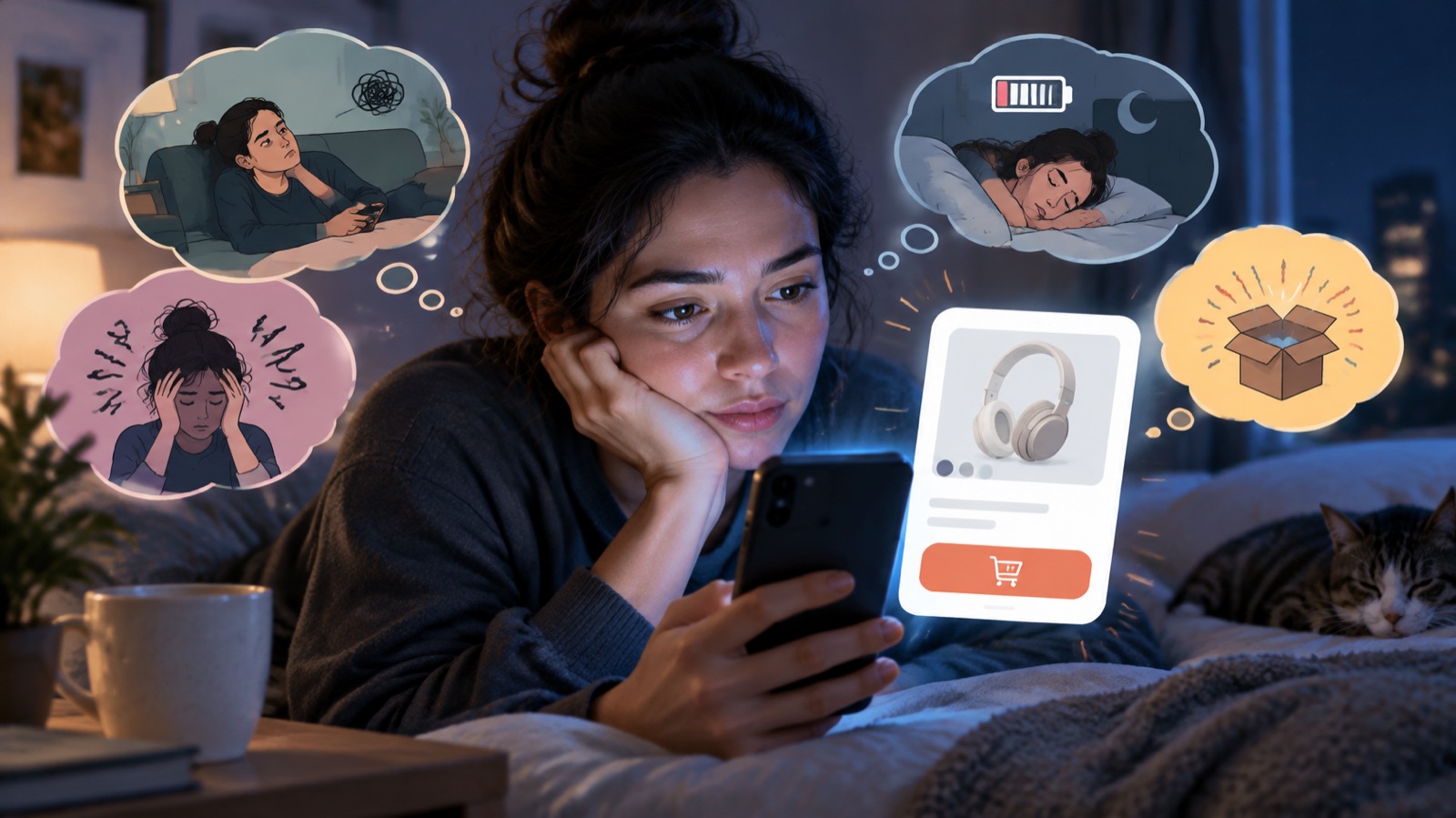
It's almost midnight. You opened your phone to answer one message, and somehow there's an order confirmation in your inbox. The thing you bought isn't really the story. What happened in the ten minutes before it usually is.
In short: ADHD makes impulse buying more likely because of differences in reward processing, a stronger pull toward immediate rewards, and emotions that arrive faster. Most impulse purchases are triggered by boredom, stress, tiredness, or novelty. Noticing the feeling before each unplanned purchase, making if-then plans, and adding a wait between the urge and the purchase all help. Finiverse builds that pause in with its Wishlist and Impulse Pause.
It isn't a willpower problem
Impulse buying gets talked about like a character test you keep failing. For a lot of ADHD brains it works more like a wiring difference. Research on the brain's reward pathways has found differences in dopamine signaling in adults with ADHD, which helps explain why something new, fast, and rewarding pulls so much harder than it seems to for other people.
Time plays a part too. A meta-analysis comparing people with and without ADHD found a consistent tendency to discount future rewards more steeply, which means money you might have next month simply feels less real than the thing you could have tomorrow. And emotions tend to arrive faster and bigger. Researchers call this emotion dysregulation, and while it isn't in the official diagnostic criteria, it shows up in a large share of adults with ADHD.
Put those three together and an impulse purchase stops looking like a lack of discipline. It looks like a brain doing exactly what it was built to do, inside an online store that was designed to take advantage of it.
The purchase is the last step, not the first
Consumer researchers have described the buying impulse as a sudden, strong urge to buy something right now, one that arrives with very little deliberation and a lot of feeling. That feeling part matters. Most impulse purchases are the end of a chain that started somewhere else: a hard conversation, a boring afternoon, a night when you were too tired to do anything but scroll.
If you only look at what you bought, you'll keep trying to fix the wrong thing. Deleting the shopping app helps for a week. Understanding why you opened it at 11:40pm helps for much longer.
The triggers that come up again and again
Boredom is a big one. When a task is dull and your brain is hunting for stimulation, browsing and buying are a quick, reliable source of something new. Hard emotions are another: stress after work, a message that stung, the low hum of anxiety you can't quite name. A purchase gives you a moment of relief and a small sense of control, which is exactly why it's so easy to reach for.
Then there's tiredness. Late at night, the part of you that would normally ask “do I need this?” is the first to clock out, and checkout pages never close. And finally there's novelty. A new interest can feel urgent in a way that's hard to explain to anyone else, and suddenly you need the gear, the books, and the starter kit before the excitement fades. Sometimes it fades three days after the box arrives.
None of these are bad on their own. Boredom, stress, tiredness, and excitement are just signals. The trouble starts when buying becomes the default way of answering them.
How to find your own triggers
You don't need a spreadsheet for this. For the next couple of weeks, every time you buy something you didn't plan to, write down three small things: what it cost, the time, and one word for how you felt right before. “Headphones, $60, 11pm, wired.” That's a complete entry.
After two weeks, read it all back in one sitting. Most people find that their impulses cluster in ways they didn't expect. Maybe it's Sunday evenings. Maybe it's the hour after a stressful call, or every time they feel left out. Once you can see the pattern, you're no longer fighting a mystery. You're responding to something specific.
Put some space between the urge and the purchase
The goal isn't to never buy anything on impulse again. It's to give the slower part of your brain a chance to catch up. One of the most reliable tools in behavior research for this is the implementation intention, a simple if-then plan you decide in advance. Across many studies, people who made specific if-then plans were noticeably more likely to follow through than people who only set the goal.
For spending, that might sound like: if I'm on a checkout page after 10pm, then I save it to a list and close the tab. If I want to buy something right after a hard conversation, then I text a friend first. The plan works because you're not making a decision in the moment. You already made it, on a calmer day.
It also helps to make the price feel real. Because future money is easy to discount, “$85” can feel like nothing. “Almost a full day of work” or “seventeen coffees” lands differently, and that small shift is often enough to turn “buy now” into “maybe later.”
When it happens anyway
Sometimes it will happen anyway. That isn't the system failing, that's being a person. The part worth protecting yourself from is the spiral afterward, where shame about one purchase turns into avoiding your banking app, which turns into not knowing where you stand, which makes the next stressful moment, and the next impulse, more likely.
Check the return window. Add it to your log with the feeling, like any other entry. Then let it go. A purchase you can learn from is useful information, not proof that you're bad with money.
How Finiverse handles this
We built Finiverse around the idea that the urge and the decision don't have to happen at the same moment. When you want something, you can put it in your Wishlist with a wait, anywhere from a day to three months, and Finiverse lets you know when it's ready and asks if you still want it. Often you don't. When you do, you get to buy it without the guilt.
Impulse Pause is for the stronger urges: a short cooldown that gives you time to breathe before you decide, plus a night pause for the late hours when your guard is down. Prices can be shown in coffees or in hours of work, so the number actually means something. And because you can tag a mood on any expense, Finiverse can start to show you which feelings tend to come before your spending, so the triggers you found on paper begin to show up on their own.
Quick answers
Why do people with ADHD impulse buy more?
Research points to differences in the brain's dopamine reward pathways, steeper discounting of future rewards, and emotion dysregulation. Together they make an immediate purchase feel more rewarding and future money feel less real. It isn't a lack of willpower.
What are the most common impulse spending triggers?
Boredom and the search for stimulation, hard emotions like stress or rejection, tiredness late at night, and the excitement of a new interest. The trigger usually happens before the purchase, so noticing how you felt right before buying is the best way to find yours.
How can I stop impulse buying with ADHD?
Aim for space, not perfection. Write down the feeling behind each unplanned purchase for two weeks, decide if-then plans in advance (for example, if I'm on a checkout page after 10pm, I save it to a list and close the tab), add a waiting period before buying, and translate prices into hours of work.
Is there an app that helps with ADHD impulse spending?
Finiverse is a personal finance app designed for ADHD and other neurodivergent brains. Its Wishlist lets you set a wait of one day to three months before buying, Impulse Pause adds a cooldown for strong urges, and mood tags on expenses show which feelings tend to come before your spending. It's free to download on the App Store.
Sources
- Volkow, N. D., Wang, G.-J., Kollins, S. H., et al. (2009). Evaluating dopamine reward pathway in ADHD: Clinical implications. JAMA, 302(10), 1084–1091.
- Jackson, J. N. S., & MacKillop, J. (2016). Attention-deficit/hyperactivity disorder and monetary delay discounting: A meta-analysis of case-control studies. Biological Psychiatry: Cognitive Neuroscience and Neuroimaging, 1(4), 316–325.
- Shaw, P., Stringaris, A., Nigg, J., & Leibenluft, E. (2014). Emotion dysregulation in attention deficit hyperactivity disorder. American Journal of Psychiatry, 171(3), 276–293.
- Rook, D. W. (1987). The buying impulse. Journal of Consumer Research, 14(2), 189–199.
- Gollwitzer, P. M. (1999). Implementation intentions: Strong effects of simple plans. American Psychologist, 54(7), 493–503.
- Gollwitzer, P. M., & Sheeran, P. (2006). Implementation intentions and goal achievement: A meta-analysis of effects and processes. Advances in Experimental Social Psychology, 38, 69–119.
Want a pause between the urge and the purchase?
Finiverse gives every want a waiting room and shows you the feelings behind your spending, without judgment.
Download Finiverse free →