
How to Save Money With ADHD (When “Future You” Feels Like a Stranger)
Published: November 19, 2026 · By Monica Becerra · 8 min read
Every money guide says the same thing: pay yourself first, put a little aside every month, think about the future. If you have ADHD, you've probably tried. Maybe it worked for three weeks. Then one month there was nothing left to put aside, or you moved the savings back "just this once", and the whole plan quietly disappeared. That doesn't mean you can't save. It means the usual advice was written for a different brain.
In short: Saving is harder with ADHD because it trades something real now for something blurry later, and ADHD brains feel the "now" much more strongly, a pattern researchers call delay discounting. Willpower doesn't fix that. What helps is taking the decision away: an automatic transfer on payday, savings you don't see in your everyday account, goals you can watch filling up, amounts small enough to feel almost silly, and a little buffer before any big goal. Taking money back out isn't failure. Sometimes it's exactly what savings are for.

Why saving feels harder with ADHD
Saving money is a strange deal when you think about it. You give up something you could have now in exchange for something you might enjoy later. Most people find that trade a little hard. With ADHD it's harder, and there's research on why.
Psychologists call it delay discounting: the tendency to value a reward less the further away it is. Everyone does it, but a meta-analysis of studies comparing people with and without ADHD found that people with ADHD discount future rewards more steeply. Money next year feels worth much less than the same money today, and the thing you could buy with it today is right there, bright and specific.
Time blindness makes it stronger. If the future feels foggy, money saved for it feels like money thrown into the fog. There's also research on the "future self": many people think about who they'll be in twenty years a bit like they think about a stranger. In one set of studies, people who saw an aged picture of their own face said they would put more money towards retirement. Your future self is a real person who will be glad you thought of them, but your brain may not quite believe it.
So when saving doesn't stick, it isn't because you don't care about your future. It's because "the future" is a hard thing for an ADHD brain to feel. The way through is to stop asking your brain to feel it, and to build a system that saves anyway.
Make saving the default, not a decision
Every time saving is a decision, it competes with everything you want right now, and right now usually wins. So take the decision away. Set up an automatic transfer to savings for the day your money comes in, before you have a chance to spend it. You decide once, on a calm day, and it keeps happening on the days when you wouldn't have chosen it.
This isn't just an ADHD trick. Some of the best-known studies in behavioural economics show how much defaults matter. When one company changed its retirement plan so that new employees were enrolled automatically, with the option to leave, far more people ended up saving than when they had to sign up themselves. Most people simply stayed with whatever happened by default. With ADHD, you can use that same effect in your favour.
If committing to an amount feels scary, borrow the idea behind a programme called Save More Tomorrow: start with a tiny amount and agree in advance to raise it later, for example the next time your income goes up. Future you takes the bigger step, and present you only has to say yes to something small.
Out of sight, in a good way
"Out of sight, out of mind" usually works against people with ADHD. Here it can work for you. If your savings sit in the same account you spend from, they look like spending money, and sooner or later they get spent. Keep them somewhere separate, ideally an account you don't see every time you open your banking app. Some people use a different bank on purpose, so that moving money back takes a day and a bit of effort. That small delay is often enough for the urge to pass.
It's the same idea as my own 3-month rule, which I wrote about in my story with ADHD and money. I don't trust myself to say no in the moment, so I put time between the urge and the decision. Separate savings put a little time between you and your savings.
But keep the goal where you can see it
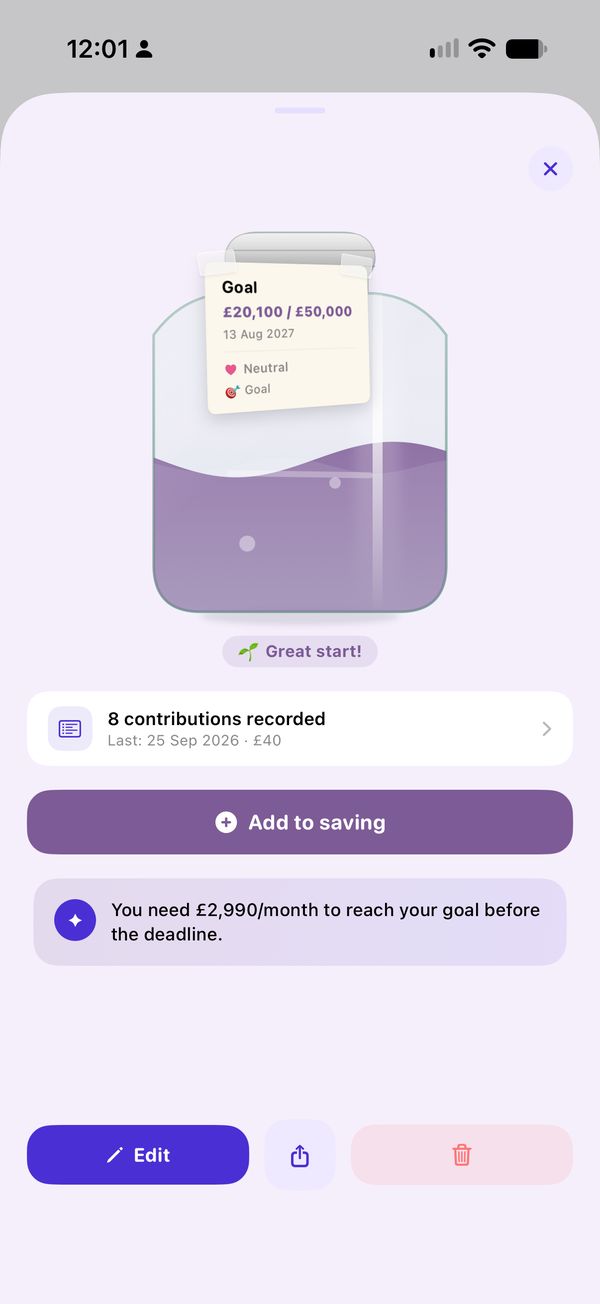
Here's the balance: the money out of sight, the goal in sight. A vague "savings" number is easy to ignore. A goal with a name is not. "Trip to see my sister in March" pulls harder than "savings". A jar that fills up says more than a figure with two decimals. And breaking a big goal into small steps gives your brain something it loves, a win it can actually feel, every few weeks instead of once a year.
Start smaller than feels useful
Many of us start saving the way we start everything else: with a burst of energy and a plan that's too big. Twenty percent of every paycheck, starting today. Then one tight month breaks the plan, and a broken plan feels like a reason to stop altogether.
Start with an amount that feels almost silly. The price of a coffee a week. Rounding up each purchase to the next whole number. At the beginning the point isn't the amount. It's proving to yourself that a saving habit can survive a bad month. You can raise it once it feels boring, and boring is a good sign. The things you decided not to buy count too: when you wait on a want and the want passes, that money stayed with you.
Build a small buffer before a big goal
If you can only save for one thing, save for a small buffer first. Not a six-month emergency fund, which can feel so far away it's paralysing. Just enough to absorb one surprise: a late fee, a lost charger, a bill that arrived earlier than you expected. With ADHD those surprises are part of life, and the ADHD tax hurts most when there's no cushion. A small buffer turns those moments from a crisis into an annoyance, and that alone can change how money feels.
When you take money back out
At some point you will move money out of savings. Maybe for an emergency, maybe for something you really wanted. That doesn't erase what you did. Savings that get used are savings that worked, and if it was an emergency, that was literally their job.
What helps is deciding ahead of time what happens next, on a calm day, so you don't have to decide it on a hard one. For example: if I take money out, the automatic transfer keeps going, and I add a little extra next month to refill it. No punishment, no starting again from zero. Just the next step.
Free on iPhone and Android. Get it on Google Play →
How Finiverse helps you save
When I built Finiverse, I wanted savings to feel like something you can see, not a number you avoid. Each goal has a name, an amount and a deadline, and it shows up as a jar that fills as you go. You can add how you feel at each step if you want to, round-up savings let small amounts add up, and the app tells you whether you're on schedule or what it would take to get there.
The Wishlist is the other half. When you want something, you can give it a wait of one day to three months, and when you decide to let it go, Finiverse shows you what you didn't spend. The home screen keeps one calm number in front of you, what's safe to spend after bills and savings, so the money you set aside doesn't look like money you can spend. The automatic transfer itself you set up with your bank. Finiverse is where you watch it grow.
Your future self is on your side
Saving with ADHD isn't about becoming someone who thinks about the future all the time. It's about building a system that remembers the future for you, while you keep living in the present like you always have. Start with one automatic transfer, one goal with a name, and an amount small enough that you can't fail at it. That's a real start. For the everyday side of money, the anti-budget is a good next read.
Quick answers
Why is it so hard to save money with ADHD?
ADHD makes future rewards feel smaller compared with rewards available now, a pattern called delay discounting, and time blindness makes the future feel far away. Saving asks you to trade something real now for something later, which is exactly the trade ADHD makes hardest. It's not a lack of caring or willpower.
What's the best way to save money with ADHD?
Make it automatic and take the decision away. Set up a transfer to savings on payday, keep your savings in a separate account you don't see every day, give each goal a name you can picture, and start with an amount small enough to survive a tough month.
How much should I save if I have ADHD?
Start with whatever feels almost too small, even the price of a coffee a week. The first goal is a habit that survives a bad month. Once it feels boring, raise it. A small buffer for surprises is a good first target before bigger goals.
Is it bad to take money out of savings?
No. Using savings for an emergency is what they're for. What helps is deciding ahead of time how you'll refill them, for example by keeping the automatic transfer going and adding a little extra the next month, so one withdrawal doesn't feel like starting over.
Is there a savings app for ADHD?
Finiverse is a personal finance app made by a founder with ADHD for neurodivergent brains. Goals show up as a savings jar that fills as you go, with round-up savings, and the Wishlist lets you wait before buying and see what you didn't spend. It's free on the App Store and Google Play.
Sources
- Jackson, J. N. S., & MacKillop, J. (2016). Attention-deficit/hyperactivity disorder and monetary delay discounting: A meta-analysis of case-control studies. Biological Psychiatry: Cognitive Neuroscience and Neuroimaging, 1(4), 316–325.
- Barkley, R. A. (1997). Behavioral inhibition, sustained attention, and executive functions: constructing a unifying theory of ADHD. Psychological Bulletin, 121(1), 65–94.
- Hershfield, H. E., Goldstein, D. G., Sharpe, W. F., Fox, J., Yeykelis, L., Carstensen, L. L., & Bailenson, J. N. (2011). Increasing saving behavior through age-progressed renderings of the future self. Journal of Marketing Research, 48(SPL), S23–S37.
- Madrian, B. C., & Shea, D. F. (2001). The power of suggestion: Inertia in 401(k) participation and savings behavior. The Quarterly Journal of Economics, 116(4), 1149–1187.
- Thaler, R. H., & Benartzi, S. (2004). Save More Tomorrow: Using behavioral economics to increase employee saving. Journal of Political Economy, 112(S1), S164–S187.
Start with one small goal.
Give it a name, watch the jar fill, and let Finiverse remember the future for you.
Download Finiverse free →Free on iPhone and Android. Get it on Google Play →