
Diagnosed with ADHD at 27: My Story With Money (and Why I Built Finiverse)
Published: November 4, 2026 · By Monica Becerra · 7 min read
I have travelled, worked for international companies and moved abroad on my own to study a master's. I also have ADHD, and I wasn't diagnosed until I was 27. From the outside it can look like I had everything under control. From the inside, every one of those things took a lot of work that nobody could see. This is the part of the story I don't usually tell.
In short: When I was diagnosed with ADHD at 27, my whole life finally had an answer, and I learned I also live with anxiety. I still travelled, worked internationally and moved abroad alone for a master's, but none of it was easy, and living abroad forced me to get strict with money. What helped most is the 3-month rule: when I want something, I wait three months, and if I still want it, I buy it. Finiverse started as a spreadsheet my sister asked for and became an app built the way my brain works. Money still overwhelms me, and some days I feel a little lost. That's why the app exists: to help people become more independent with money, in a way that is compassionate but realistic.

Founder of Finiverse. ADHD, anxiety, and a lot of learning as I go.
A diagnosis at 27: my whole life finally had an answer
When I was diagnosed at 27, it felt like my whole life suddenly had an answer. All the moments I never understood, all the times I thought I was simply doing life wrong, finally had a name. For the first time, I could put a name to my past and to my own experience.
And it wasn't only ADHD. I also live with anxiety. The two feed each other. ADHD makes me forget things or act on impulse, and anxiety makes me replay it for days. With money, that combination is exhausting. A forgotten payment isn't just a fee. It's a knot in my stomach that doesn't go away. I wrote more about those costs in the ADHD tax.
The diagnosis didn't fix anything by itself. But it changed the question I asked myself, from "what's wrong with me?" to "what does my brain need?" And it let me look back at the younger Monica with much more tenderness.
It didn't stop me. It made everything cost more
I don't want this to sound like a success story where ADHD was a small detail. It wasn't. Travelling, working for international companies, moving to another country alone to study: I did all of it with ADHD, and each one took more effort than it looked like from the outside.
I'm writing this because, years ago, I would have liked to read that you can have ADHD and still do the big things. It may cost you more. It's still possible.
Living abroad: I starved my impulse to buy
Living abroad on my own meant I had to be much stricter with money. Basically, I starved my impulse to buy. Not because I stopped wanting things. ADHD doesn't work like that. The urge was still there, as loud as ever. I just stopped feeding it.
With ADHD, impulse buying isn't a lack of willpower. The reward in front of you feels bigger than anything that comes later, and emotions arrive fast. I explain the science in the article on ADHD spending triggers. So "just don't buy it" never worked for me. What worked was putting time between the urge and the decision.
The 3-month rule
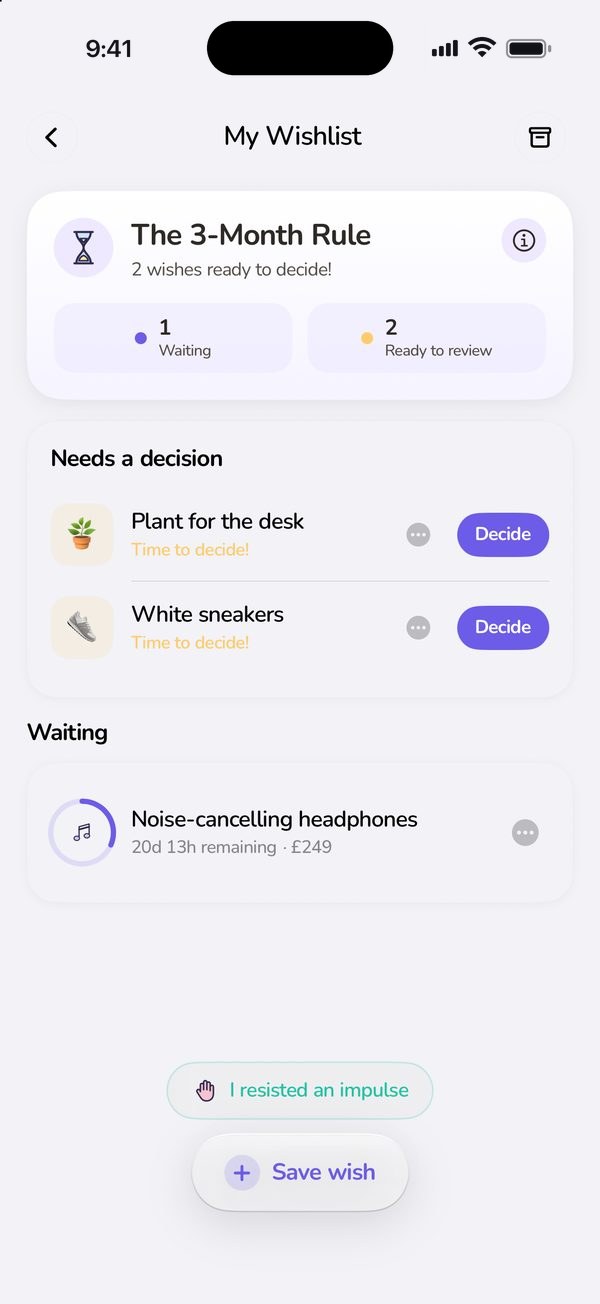
Since 2020 I've used one simple rule. When I want something that isn't a need, I don't buy it right then. I write it down and wait three months. If after three months I still want it, and it fits, I buy it, without guilt. Most of the time, by then, I've forgotten about it, or I look at it and feel nothing.
It works for my brain because it doesn't ask me to say no. It asks me to say "not yet," which is much easier to hear. The urge gets written down, so it isn't lost. And three months is long enough for the rush of the moment to fade, so the calmer version of me gets to decide. If waiting feels impossible and the buying has become a loop, I wrote a separate guide on ADHD shopping addiction.
A spreadsheet for my sister that became an app
Finiverse started with a small request. My sister asked me to make her an Excel to organise her money. And my ADHD brain said: what if I make an app instead? If you have ADHD, you know that moment. The idea arrives, and suddenly it's the only thing you can think about.
I didn't know how to code. I learned Xcode with Google and YouTube, one error at a time. Over time I started leaning on AI too, because I wasn't an expert, and it could see mistakes that I couldn't. It became a second pair of eyes.
Somewhere along the way I realised something. I was building the app the way my brain works. One calm number instead of ten. A pause before buying. Envelopes and colours instead of columns of figures. Reminders that remember for me. It wasn't a business plan. It was me making something I could actually use.
I still get overwhelmed
I'd love to end this by saying I've figured it out. I haven't. Money is still a topic that stresses me out. Some days I open my accounts and feel overwhelmed before I've read a single number. And I still catch myself punishing myself: for a purchase, for a forgotten payment, for not being "better" at this by now.
I'm working on it. I'm learning that feeling overwhelmed doesn't mean I'm failing, and that punishing myself has never fixed a single money problem. It only makes me avoid looking, and that makes the next problem bigger. So I try to treat myself the way I'd treat a friend: with patience, and with one small next step.
There were moments, and there still are, when I feel a little lost. Not knowing where to start. Feeling like everyone else was handed a manual that never reached me. I've learned not to hide those moments, because pretending I'm fine has never made them shorter.
What Finiverse is really for
That feeling of being lost is the reason Finiverse exists. In the end, the goal of the app is simple: to help. To help you become more independent with your money, so you don't need someone else to make sense of it for you, or a perfect day to remember everything. And to do it in a way that is compassionate, but realistic.
Compassionate, because shame has never helped anyone pay a bill. Realistic, because a kindness that hides the numbers doesn't help either. Finiverse won't scold you, and it won't pretend everything is fine when it isn't. It tells you the truth gently, and then shows you one small next step. On hard days you can hide your balances. And when you add a mood to a purchase, it isn't to judge it. It's to understand it.
I built it for the version of me who felt lost. If you feel that way right now, I built it for you too.
If you have ADHD and money stresses you out
You're not bad with money, and feeling lost doesn't mean you are lost. Your brain needs a different system, and you're allowed to build one that fits you, even if it looks strange to everyone else. Mine started with a three-month wait and a spreadsheet for my sister. Yours can start with something just as small. If you want more ideas, this guide to ADHD and money is a good next read.
Quick answers
Can you be diagnosed with ADHD as an adult?
Yes. Many people are diagnosed as adults, often after years of thinking their struggles were personal failings. I was diagnosed at 27. If you recognise yourself in ADHD, a doctor or psychologist who assesses adults can help.
Can ADHD and anxiety happen together?
Yes, and it's common. Many adults with ADHD also live with anxiety. They can feed each other: ADHD leads to a missed payment or an impulse buy, and anxiety replays it for days, which can make you avoid looking at your money at all. A professional can help with both.
What is the 3-month rule for spending?
It's a simple waiting rule. When you want something that isn't a need, you write it down and wait three months before buying it. If you still want it and it fits your budget, you buy it without guilt. Often the urge has passed by then. It suits ADHD because it says "not yet" instead of "no."
How do you control impulse buying with ADHD?
Willpower alone rarely works, because ADHD makes the reward in front of you feel bigger than anything later. What helps is putting time and steps between the urge and the purchase: a waiting rule, removing saved cards from shopping sites, and noticing which moods tend to come before spending.
Is there a money app made for ADHD brains?
Finiverse is a personal finance app made by a founder with ADHD for neurodivergent brains. It has a Wishlist where you set a wait of one day to three months before buying, an Impulse Pause, one safe-to-spend number, and mood tags on expenses. It's free on the App Store, and the Android version is in beta, open to testers.
You're not alone in this.
If this story felt familiar, start with something small: one wish, one wait. I built Finiverse for you too.
Download the app I built for you →Free on iPhone and Android. Get it on Google Play →