
ADHD and Dyscalculia: When Both Show Up in Your Money
Published: November 16, 2026 · By Monica Becerra · 6 min read
The total flashes up at the till. You glance at it, it slides straight out of your head, and you tap your card anyway because the queue is waiting. Later you cannot say whether that shop was a lot or a little, and you are not sure if you forgot to look or never really understood the number in the first place. If you have ever asked yourself that, you are not alone: ADHD and dyscalculia turn up together more often than most people think.
In short: ADHD and dyscalculia are separate conditions that often occur together. ADHD makes it hard to keep your attention on numbers; dyscalculia makes the numbers themselves hard to grasp. With money, the two stack up: amounts slip away, and they were hard to judge in the first place. What helps is fewer numbers, fewer steps, and systems that work without remembering or calculating in the moment.
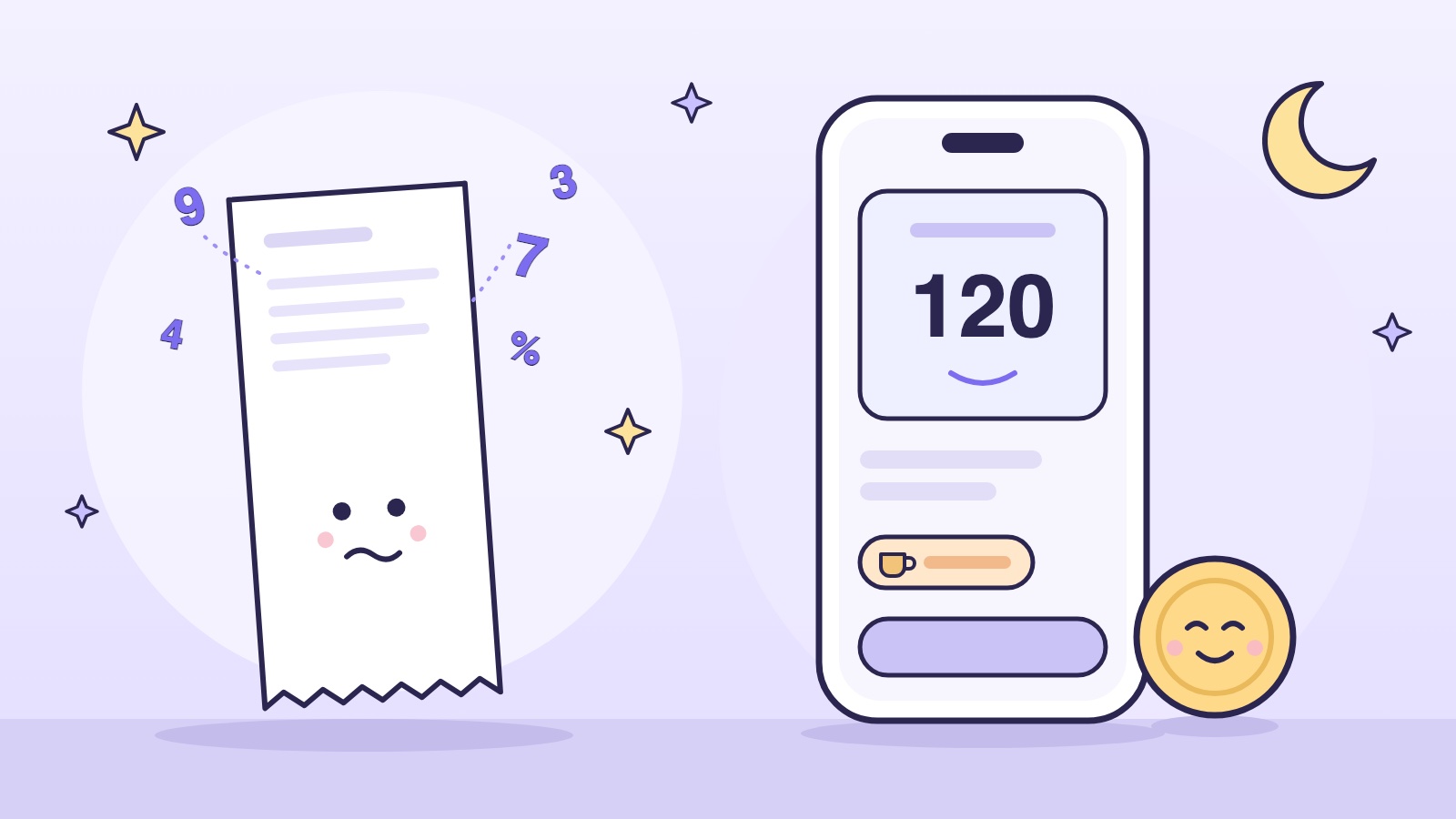
How often ADHD and dyscalculia come together
Dyscalculia is a specific, lasting difficulty with numbers: sensing quantities, comparing them and doing basic arithmetic, in people whose intelligence and schooling are otherwise fine. ADHD is a difference in attention, impulse control and the brain's management system, often called executive function. They are not the same thing, but they keep turning up in the same people.
In an Israeli study of 140 children with dyscalculia, 26 percent also had symptoms of ADHD. Looking from the other side, a Canadian study of 476 children with ADHD found that 18 percent also had a mathematics disorder, and the authors concluded that these difficulties could not simply be explained as a consequence of ADHD. Both studies are about children, and research on adults is much thinner, but neither condition tends to fade with age. Many adults only put a name to one of them, or to both, years later.
Attention slip or number trouble? How to tell them apart
From the outside, both look the same: being “bad with money”. From the inside, they feel different, and noticing which one is happening helps you pick the right fix.
- More like ADHD: you can do the sum when you are calm and focused, but you skip a line, forget a bill, lose the total halfway, or never open the banking app at all. The trouble is getting your attention onto the numbers and keeping it there.
- More like dyscalculia: even with time and quiet, the numbers stay foggy. It is hard to sense whether 40 is a lot for a dinner, to compare two prices, to tell 1,500 from 15,000 at a glance, or to know roughly what change to expect. The trouble is what the numbers mean.
- Both: the number is hard to grasp and hard to hold on to, so it slips away before you have made sense of it. That is the combination this article is about.
This is not a diagnosis. Only a qualified professional can assess either condition, and stress or money anxiety can make anyone's numbers foggy for a while. But naming the pattern is often the first step to being kinder to yourself about it.
Why money gets twice as hard
Money asks for both skills at once, usually in a hurry. A card payment wants a quick judgement. A bill wants you to remember it and understand it. A budget wants steady attention and arithmetic, week after week. When one of those skills is shaky, you can lean on the other. When both are, there is nothing to lean on, and the easiest move is to stop looking.
Research on each condition on its own already shows the cost. In a Dutch study, adults with ADHD reported less income, more debt and fewer savings accounts than adults without ADHD. They also scored lower on tasks like understanding a bank statement, and more often described buying on impulse and avoiding financial decisions. On the number side, a British study that followed people born in 1970 found that poor number skills were linked with lower pay and lower economic well-being by age 30, even more than poor reading skills. Neither study looked at people with both conditions, so nobody can give you a combined figure, but it is easy to see how the two add up.
Then comes the emotional part. Each missed bill or confusing statement feels like proof that you are hopeless with money, so you look less, which brings more surprises, which feel like more proof. That loop has far more to do with avoidance and shame than with intelligence, and breaking it starts with making money easier to look at. We wrote more about how that chain can turn into debt.
What helps when you have both
The trick is to choose tools that remove numbers and remove steps at the same time. Advice that only fixes one side, like a detailed spreadsheet or a long list of reminders, tends to fail people who have both.
- Automate payday. Set your bills and a small saving to leave your account on the day you get paid. Nothing to remember, nothing to calculate, no decision in the moment.
- Watch one number. What you can safely spend until your next payday is enough for most days. Leave the rest alone unless you need it.
- Translate amounts into things. “About three lunches” or “two hours of work” is easier to judge than a price, and it sticks better too.
- Put a wait before buying. A pause gives your attention time to come back and the number time to make sense. My own rule, since 2020, is three months for things I want. Even one day helps.
- Prepare cash at home. Decide which notes to bring before you leave, or pay with one larger note, so you do not have to count change while someone waits.
- Keep a tiny, fixed check-in. Five minutes, the same day each week, with a drink you like. Short and predictable beats long and perfect.
- Ask for help without apologising. Asking your bank to explain a charge in plain words, or a friend to sit with you while you open your letters, is a reasonable adjustment, not a failure.
Free on iPhone and Android. Get it on Google Play →
How Finiverse helps with this
I have ADHD, and I built Finiverse for brains that find money hard for more than one reason. It is not a treatment and it cannot assess anyone, but it is designed to take numbers and steps off your plate. Home leads with one calm number, what is safe to spend after bills and savings. Whole amounts drop the “.00”, and your records always show the total for the period, so you never have to add anything up in your head.
For the moment of buying, you can see prices in coffees or in hours of work, put a want on your Wishlist with a wait from a day to 3 months, or use Impulse Pause when the urge hits. For cash, a step-by-step guide shows which notes and coins to hand over and what change to expect, and it can read each step out loud. And Sam, the assistant inside the app, does the maths before answering and explains amounts with everyday comparisons, never with judgement. For more, read dyscalculia and money and ADHD and money.
Quick answers
Can you have ADHD and dyscalculia at the same time?
Yes. They are separate conditions, but they often occur together. In one study of children with dyscalculia, about a quarter also had ADHD symptoms, and in another study of children with ADHD, about 18 percent also had a mathematics disorder.
How can I tell if my money struggles come from ADHD or dyscalculia?
A rough sign: if you can do the maths when calm and focused but keep losing track, forgetting or avoiding it, attention is likely the bigger part. If numbers stay hard to grasp even with time and quiet, dyscalculia may be involved. Many people have both, and only a qualified professional can assess either.
Can adults be assessed for dyscalculia?
Yes. Dyscalculia does not usually go away with age, and adults can be assessed, often by an educational psychologist or a specialist assessor. If you already see a doctor or clinician for ADHD, they can point you to options near you.
Is there an app for ADHD and dyscalculia?
Finiverse is a personal finance app built for neurodivergent people. It shows one calm safe-to-spend number, drops the “.00”, shows prices in coffees or hours of work, and has a step-by-step cash guide, a Wishlist with a wait, Impulse Pause, and Sam, an AI assistant that does the maths and never judges. It is free to download on the App Store.
Sources
- Bangma, D. F., Koerts, J., Fuermaier, A. B. M., Mette, C., Zimmermann, M., Toussaint, A. K., Tucha, L., & Tucha, O. (2019). Financial decision-making in adults with ADHD. Neuropsychology, 33(8), 1065–1077.
- Butterworth, B., Varma, S., & Laurillard, D. (2011). Dyscalculia: From brain to education. Science, 332(6033), 1049–1053.
- Capano, L., Minden, D., Chen, S. X., Schachar, R. J., & Ickowicz, A. (2008). Mathematical learning disorder in school-age children with attention-deficit hyperactivity disorder. Canadian Journal of Psychiatry, 53(6), 392–399.
- Gross-Tsur, V., Manor, O., & Shalev, R. S. (1996). Developmental dyscalculia: Prevalence and demographic features. Developmental Medicine & Child Neurology, 38(1), 25–33.
- Parsons, S., & Bynner, J. (2005). Does numeracy matter more? London: National Research and Development Centre for Adult Literacy and Numeracy.
Fewer numbers. Fewer steps.
Finiverse does the counting and the remembering, so your energy can go into the decisions.
Download Finiverse free →Free on iPhone and Android. Get it on Google Play →